

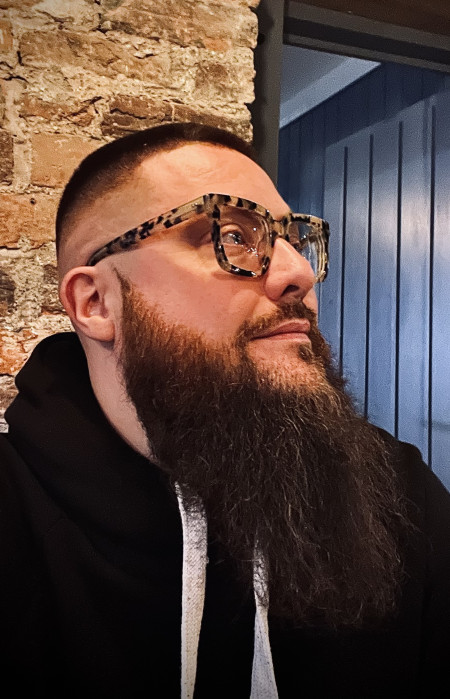
Dr Ben Evans
Lecturer In Education
School of Education, Childhood, Youth & Sport
Biography
- PhD Education, University of Leeds
- M.Sc. Education (digital technology and learning), University of Oxford
- PGCE/QTS (secondary music), University of Cambridge
- B.A. (Hons) Music, University of York
Teaching Interests
I am a Lecturer in Education in the School of Education, Childhood, Youth and Sport (ECYS) which is situated in the Faculty of Wellbeing, Education and Language Studies. I teach on postgraduate education modules, with a particular focus on inclusion and learning and teaching. These courses support the development of reflective, evidence-informed practitioners and researchers. I am also an Associate Lecturer for E320 an undergraduate module which explores polemics around carrying out research with young people. I'm currently supervising students to complete their EdD and PhD programmes also.
I am passionate about creating inclusive, engaging and supportive learning environments that enable our students to develop the knowledge, skills, and confidence to succeed in their academic and professional lives.
Other duties include co-lead for Generative AI (ECYS), and Academic Conduct Officer for the postgraduate programme. This work is driven by a commitment to inclusive education, academic integrity, and the thoughtful integration of emerging technologies into higher education.
Doctoral supervisory interests typically take in education, digital technology for learning and music education contexts. I very much welcome any potential postgraduate researchers to get in touch to discuss a proposal.
Research Interests
My research expands outward from issues in digitally-mediated learning in (musical) educational settings. Specifically, how digital technology and music making might facilitate the development of young people’s social capital within institutions and make visible disparities between young people’s lived experience and the intuitions designed to serve them. This interest has spurned investigation into hidden curricula, decolonialised learning and social justice cases in educational, community and globalised settings.
More recently, my interests are around SEND and music education, specially exploring the role of music education for preperation of adulthood. With my colleague Dr. Liz Smith, we are seeking to understand how musical experiences might help SEND students better prepare for life beyond their statutory eduction.
A further research project is funded by the OU's Research Enterprise and Scholarship Unit. It's titled: ‘Music Talks: Young people with adverse childhood experience share their musical stories via podcasting’. This UK-based project is intent upon better understanding how those facing childhood adversity integrate music into their lives and how this practice intersects with a school-based music education. Music Talks adopts a podcasting methodology to unearth young people's relationship with music and how this relationship aligns with, or departs from their experience of formal music education. Ultimately, participant co-researchers are invited to co-construct a new curriculum for music education, which will be presented to policy makers and music education organisations/lobby groups.
Previously, I've led an ambitious project to unearth the lived experiences of postgraduate researchers (PGRs) reading for Doctoral pathways at The Open University. This research aimed to connect with our PGRs in new ways. Rather than anonymous surveys, we were seeking co-researchers to share their lived experiences in an auto and duo ethnographic fashion. A qualitative and emergent participatory research design, one founded on phenomenological and social constructivist assumptions, provided PGRs with multiple pathways for how they’d like to participate (which included the submission of artefacts such as poems and photographs).
Theoretical perspectives
Speaking more broadly, I seek to empirically understand how situated communities develop their conventions/rules and products. This broad intent segways into research interests in communication (language, signs, multimodality) digital technology, mediated action, social culturalism and systems of activity. Thus, my research typically builds out from the writings of Wertsch who argues that:
'...human action typically employs "mediational means" such as tools and language, and that these mediational means shape the action in essential ways' (Wertsch, 1991, p.12).
An interest in mediated action began when I was introduced to computer-based cognitive tools while studying digitally-mediated learning as a postgraduate. These tools promise to distribute cognitive load between computer and human in ways which ensure human's peculiar goal is achieved, even if it hither-to remained out-of-reach.
These philosophical foundations situated an investigation into the role of classroom music education in community development, which formed my PhD. That research argues that the music classroom might be redefined by its situation in time and space: a place where young people's culturally constructed musical relationships collide with formalised institutional agendas to forge new community conventions. I investigated how institutional rules, digital technology and young people's personal relationship with music can simultaneously mediate creative behavior in ways which mirror local communities more authentically. That is, creative activity which seeks to make use of and develop participants' social capital to redress power asymmetries which might otherwise arise during classroom activity.
- Wertsch, J. (1991). Voices of the Mind: A Sociocultural Approach to Mediated Action. Cambridge, Massachusetts, Harvard University Press.
Teaching Interests
Inclusive practice; learning and teaching; music education; digitally-mediated interaction; activity theory; participatory approaches to carrying out research with young people; theories of creativity; social (in)justice; theories of trust and power; signs and multimodality.
Current Research Activity
Music for adulthood: The value of music making for students with severe learning difficulties (SLD) (Co-PI role)
Music Talks: The music and me podcasts. Young people with adverse experience share their musical stories via podcasting and app-based tools (PI role)
The Lived Experienced of WELS PGRs: a phenomenological and participatory investigation unearthing postgraduate experience of the PhD, EdD and DHSC Doctoral pathways at the Open University (PI role/project manager)
PhD Supervision
Geroge Curry (EdD) 'Children as musicians: Creative approaches to exploring how 7–11-year-old pupils represent their musical identity and experiences in two English primary schools'
Singay Singay (PhD): ‘ “Speak English only”: A Case Study of Translanguaging in English Medium Instruction Schools in Bhutan’
Recent Publications
[Forthcoming] Wills, N & Evans, B. (2026) 'Why and How to Teach Mathematics with Technology'. In Learning to Teach Mathematics in the Secondary School (eds. Lee, Clare and Marschall, Gosia). Taylor and Francis, London. ISBN: 9781041282808.
Singay, Shrestha, P., & Evans, B. (2026). Translanguaging in English Medium Instruction Classrooms: A Qualitative Research Synthesis of Perceptions, Practices, and Pathways to Equity, Inclusion, and Epistemic Justice. Research Synthesis in Applied Linguistics, 1–23. https://doi.org/10.1080/29984475.2026.2635490
Morris, A. E., & Evans, B. (2023). Experiences of African American Spanish Learners in the US: mitigating racialization and fostering belonging through an inclusive curriculum. Journal of Spanish Language Teaching, 10(2), 138–154. https://doi.org/10.1080/23247797.2023.2294633
Memberships
International Society for Music Education
Society for Education, Music and Psychology Research


