

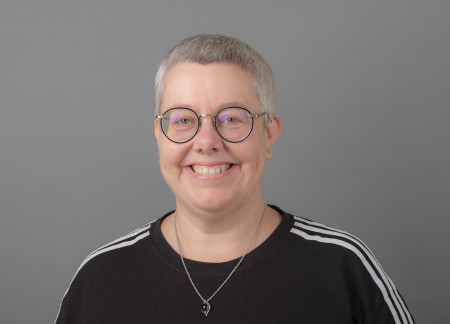
Prf Caroline Derry
Professor Of Feminism, Law And History
Biography
Professional biography
Caroline Derry is Professor of Feminism, Law and History. She has been an academic for over 20 years and joined the Open University in April 2017, teaching subjects including criminal and evidence law. She is academic lead for the forthcoming LLM Law; previous roles included Deputy Director Research Degrees and Law School EDI lead.
Caroline qualified as a barrister, practising in criminal defence law, and as a solicitor in a large, central London legal aid practice. She then taught at London Metropolitan University, where she was a senior lecturer in criminal and evidence law and gender & law, and course leader for the LLB Law. She has been a visiting lecturer in criminal law at SOAS and at Paris Descartes (Masters in Common Law).
Caroline is a Fellow of the Royal Historical Society and of the HEA, and a UKCGE-accredited PhD supervisor.
Research interests
Gender, sexuality and criminal law, particularly temporalities, the law on sexual consent, and the legal regulation of relationships between women from the seventeenth century to the present. Caroline is jointly leading an interdisciplinary project on '1885 and its long shadow: sexual offences in historical context'.
Recent invited presentations include 'Fighting the sexual double standard and raising the age of consent, 1885-1922' (Women's Library centenary conference, LSE, 2026), ‘Legal temporalities of sexual consent’, Consent, Law and Technology Workshop (OU Centre for Protecting Women Online, 2025), and ‘Louise Mourey, the Labouchère amendment, and the non-criminalisation of sex between women’ (Oscar Wilde, Sexuality & the State, UCLA, 2024). She has also discussed her research on the Not for want of trying podcast.
Recent work on law and literature focuses upon lesbianism in Agatha Christie's novels and the criminal courts. It is being shared with academic and public audiences including as a speaker at the International Agatha Christie Festival and a guest on the Tea and Murder podcast.
Early women lawyers: Caroline researches several of the first women to qualify as barristers in Britain (including those who practised in England and Wales as well as Malawi and Tanzania's first Black woman barrister). She has published and presented widely on these, and on feminist biographical methodologies, and is a participant in projects on the first women lawyers and early ethnic minority lawyers.
Caroline is academic lead of the Legal Histories research cluster, whose activities include the annual Diversity, Dilemmas and Discoveries conference series which attracts international participation. Themes have included women's entry into the legal profession, histories of legal education, legal history in the curriculum, legal histories/local histories, and legal history in unexpected places. She co-edited a collection on Legal History in the Curriculum. She is also the former convenor of the Society of Legal Scholars' Legal History Subject Section.
Teaching interests
Access:
- Y035 Business and law Access
Undergraduate:
- W111 Criminal law and the courts
- W250 Evidence law.
- W340 Law, society and culture
Postgraduate:
- LLM Law
- PhD research training seminars
Prior to working at the Open University, Caroline led a range of undergraduate and postgraduate modules including:
- Criminal Law
- Evidence and Advocacy
- Gender and Law
- Gender and Human Rights
- Criminal Justice and Human Rights
She is the co-author of textbooks including Complete Criminal Law, 6th-8th editions (with Janet Loveless and Mischa Allen, OUP, 2018, 2020, 2022 and 2025) and Gender and Law (with Judith Bourne, Routledge, 2018).
Impact and engagement
Caroline has contributed to a range of consultations including the UK Government consultation on evidence in sexual offences, Scottish Goverment consultations on victims' rights and the not proven verdict, and the Criminal Law Reform Now Network project 'Reforming the Relationship between Sexual Consent, Deception and Mistake'.
She has published in the Law Society Gazette, The Conversation and OpenLearn, and contributed to exhibitions and events at the Inns of Court. Blog posts include:
- ‘The (non-)use of history and its significance in “For Women Scotland”’ (2025) 14(2) Feminists at Law
- ‘Legal contributions to social history: when a dozen words make a difference‘, Journal of Law & Society Conversations (31 October 2022).
- ‘Early ethnic minority barristers & the Inns of Court’ with Miriam Mbah, Open Justice blog (Open University, 25 March 2022).
- ‘Covid-19, criminalisation and compliance: perspectives from health studies and law’ with Yolanda Eraso and Matthew Howard, SLSA Blog (9 December 2021).
Caroline's EDI work has been shared at conferences and events including the Association of Law Teachers' annual conference, AdvanceHE EDI Conferences, a Lincoln's Inn qualifying session on Gender Inequality and Intersectional Discrimination, and on OpenLearn, and in public talks for LGBT+ History Month. She has led research on the experiences of Gypsy, Roma, Traveller, Showman and Boater students in higher education distance learning (book chapter forthcoming) and is co-investigator in research on the experiences of LGBTQI+ distance learners.
Publications
Book
Celebrating Women in Legal History: Making and Shaping a Discipline (2026)
Legal Temporalities of Sexual Consent (2025)
Law in Motion: 50 Years of Legal Change (2020)
Lesbianism and the Criminal Law: Three Centuries of Regulation in England and Wales (2020)
Book Chapter
Selden's Sister and Women in Legal History (2026)
The Wolfenden Report, homosexuality, and women (2026)
Feminist legal history at the heart of the law curriculum (2025)
Criminal Law Amendment Act 1922 (2024)
Monica Geikie Cobb, First Woman Barrister to Appear in Court, 1922 (2024)
Beyond firsts: feminist biography and early women barristers (2023)
Sustained identity deceptions (2023)
Consenting to Sexual Activity (2020)
Digital Artefact
Cobb, Monica Mary Geikie (1891–1946) (2018)
Ashford, Ethel Bright (1883–1980) (2018)
Clapham, Olive Catherine [married name Miles] (1898–1973) (2018)
Journal Article
Messages to the future? Lesbian subversion of official categories in the 1921 UK census (2026)
Imagined biographies: Vera Mlangazua Chirwa, empire and resistance (2026)
Ethel Bright Ashford: more and less than a role model (2020)
‘Female Husbands’, Community and Courts in the Eighteenth Century (2017)


