

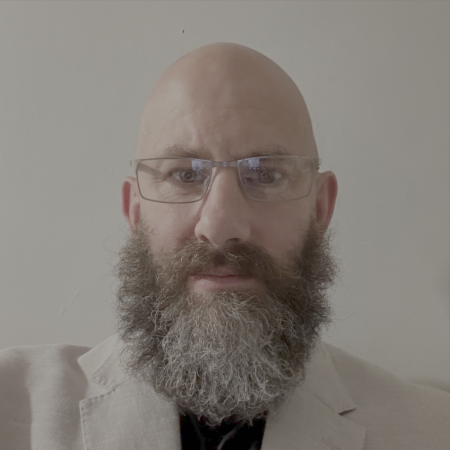
Mr Christopher Searle
Research Student
Faculty of Arts & Social Sciences
Biography
Professional Biography
Christopher John Searle is a Postgraduate Research Student in the PhD programme in Philosophy at The Open University. He has been at the OU since October 2022. Prior to commencing his PhD, Chris has been working principally as a CEO in the climbing industry.
Chris received his MA in 2003 from the University of Kent. He completed his BA(Hons) in Philosophy at Canterbury, and more recently undertook the CHE in Philosophy from the University of Oxford, and the PGCert in Philosophy from the University of Cambridge.
His specialism is metaphilosophy, but his research also straddles philosophical logic and the philosophy of language.
The principal area of his doctoral research is entailment barriers, with a particular focus on observation, logical consequence, and the elimination of metaphysics. His thesis is entitled Entailment Barriers: Observation and Logical Consequence.
Chris is also interested in the foundational questions underlying these projects, including the value and function of philosophy, the limits of derivation from observational premises, and the prospects of combining a speaker-meaning account with a modified verification principle.
Selected Publications:
Searle, C.J., 2024. Barriers to Entailment by Gillian Russell. Philosophy Now, (165), 1 December. Available at: https://philosophynow.org/issues/165/Barriers_to_Entailment_by_Gillian_Russell
Searle, C. (2022). Swinburne’s Substance Dualism. Oxford Philosophical Review. OUDCE.
Searle, C. (2021). Logic Oughtn't to be Normative. Disputatio, 1 (22),3-10.
Searle, C. (2020). Qualia ain’t out there either. Think, 19(54), 31-35.
Research Interests
Chris has a wide range of philosophical interests, including logical empiricism; verificationism; applied epistemology; informal logic and syllogistic; philosophical methodology, expressivism and non-cognitivism; moral dilemmas and paradoxes in metaethics; the analytic-synthetic distinction; a priori defeasibility; and no-ownership theories of personal identity.
Philosophical questions underpinning Chris’ research include:
What is the function of philosophy?
What, if anything, is distinctive about philosophical inquiry?
Are there methods, or methodologies, that are exclusive to philosophy?
What are the limits of derivation from observational premises?
Can metaphysical conclusions be entailed by empirical or observational premises alone?
Are philosophical disputes verbal, substantive, or some combination of both?
What is the value of philosophy?
Teaching interests
Chris is currently working on developing a street epistemology programme for primary schools and is undertaking The Philosophy Foundation Philosophy in Schools course.
In regard to teaching, he is particularly interested in the following:
Pop-philosophy
The Socratic Method
Syllogistic
Informal Logic
Critical Thinking in the Workplace
Impact and Engagement
When not philosophising from the comfort of his armchair, Chris is also the CEO of Chimera Climbing.
Chris has recently developed an online educational tool for analysing and evaluating syllogistic arguments. It is available here. Users can simply plug in their own terms and assess the argument’s validity or soundness.
Chris has also been developing an educational and recreational card game that combines the medieval logic of obligationes with the classical syllogistic.
Chris writes the occasional poem and has had some poetry published in the Oxford University Student newspaper, Cherwell.
In 2022, Chris won the Chadwick Prize for the Oxford Philosophical Society.
Although still in the early stage of development, Chris has also been working on a children’s introductory book to syllogism, a comic primer entitled Doctor Morosopher.


