

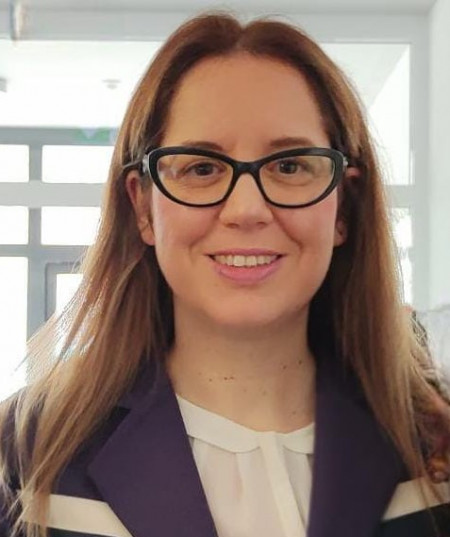
Dr Mara Fuertes Gutierrez
Senior Lecturer In Spanish
School of Languages & Applied Linguistics
mara.fuertes-gutierrez@open.ac.uk
Biography
I am an applied linguist with a strong focus on Spanish Language Teaching and the broader field of languages education. My work explores research-informed language teaching pedagogies, with a particular emphasis on teacher education, technology-mediated language teaching and inclusive curriculum design. Guided by frameworks from critical sociolinguistics and related perspectives, I investigate how language teaching can better reflect the social, cultural, and political realities of teachers and learners. I have recently co-lead the Diasporic identities and politics of language teaching strand of the AHRC-funded Language Acts and Worldmaking project and lead the Erasmus+ Project MOOC2Move, and I am currently working on my project CLAVE: Critical Approaches to Linguistic Variation in UK Higher Education: Investigating the Gap between Spanish Language Instructors’ Claims and Pedagogical Implementation, funded by the British Academy/Leverhulme. I have also a developing interest in research synthesis in Applied Linguistics.
I have more than 20 years' experience teaching Spanish and Linguistics in higher education institutions, mainly in Spain and the UK. I am currently the Languages Post-Graduate Research Convenor and have previously occupied a variety of roles, including Head of Spanish at the School of Languages and Applied Linguistics, Faculty representative at the Student Research Project Panel, and member of the Praxis steering committee and the Inclusive Curriculum Task and Finish group at the Open University. I am currently supervising several PhD researchers in the fields of Languages Education, Spanish Language Teaching and Teachers' Professional Development, and welcome new potential supervisees in these and other concomitant areas.
Before joining the Open University, I was a Senior Lecturer in Spanish at Leeds Becket University for a number of years, where I carried out several roles, such as Period Abroad Academic Leader or Course Leader for all the Languages Full-Time Undergraduate Courses. Previously, I held several research fellowships, including a Post-Doctoral Fellowship at the University of Manchester funded by the Spanish government, and taught Spanish at several institutions, namely the Instituto Cervantes in Manchester.
I have received several prizes, amongst others two Undergraduate Extraordinary Academic Achievement Awards and a PhD Academic Achievement Award. In addition, I have been nominated or shortlisted for several “Achieving Excellence Awards” (granted by Leeds Beckett University) and “Golden Robes” (granted by the Student Union at Leeds Beckett University) including Innovative Teacher of the Year (2010); Course Leader of the Year (2012); Fantastic Feedback (2015); Innovative Tutor (2015); Motivator of the Year (2015); Personal Tutor (2015).
Outside the Open University, recognition of my expertise in Spanish Language Teaching is evidenced in my executive roles in the Association of Spanish as a Foreign Language Teaching (Vicepresident), the Association of Hispanists of UK and Ireland (Secretary), and the International Association of Spanish in Society (Mentoring Scheme). I am the review coeditor of the Journal of Spanish Language Teaching (Q1, best quartile and the only journal on the subject indexed in Scopus).
Across research, teaching, and professional engagement, I am committed to advancing languages education that is reflective, socially responsive, and grounded in robust theoretical insights.
Projects
Language Acts and Worldmaking
Our project is inspired by the conviction that language learning plays a vital role in our globalised world, not as a neutral instrument of globalization—a commercialised skill set—but as a means to understand and critically engage with the world. As Franz Fanon put it: ‘To speak a language is to take on a world, a culture’. For us, ‘to take on’ means both to acquire and to combat. Our context, therefore, is recent research that places language and multilingualism at the heart of attempts to rethink, from transnational and post-national perspectives, the dominant academic paradigms of national literature departments, programmes and research. The Open University will be leading strand 5 of the project: “Diasporic identities and the politics of modern language teaching”. As cultural transmitters, modern languages practitioners must make sense of and transfer cultural concepts, behaviours, values and attitudes as they seek to establish inter-connectedness among distinct worlds. Embodying Astrid Erll’s concept of ‘traveling memory’ (Erll, 2011), they are in a position to take advantage of new possibilities—in a world of communication flows and great migrant mobility—‘for shaping post-national citizenship and for creating new lines of solidarity within the global arena’ (Assmann, 2014, p. 548). The importance and sophistication of their work—which is fundamental to any contemporary discussion of ‘language acts and worldmaking’— is often under-valued or neglected and too often accorded second-class status in research-based Modern Language departments. Teachers’ cognition about their work—as well as their actual pedagogical practice—is influenced by beliefs and contextual factors that determine the values and attitudes they reveal to learners. As Duff and Uschida explain, socio-cultural identities and beliefs, very important in educational practice as in other aspects of social life, ‘are co-constructed, negotiated, and transformed on an ongoing basis by means of language’ (1997, p. 452). This strand investigates this vehicular role of language in making sense of the world and its history and culture. We examine this in relation to the ways in which modern languages practitioners construct and express their professional and personal identities through language, as well as through consideration of how they go about the teaching of cultural concepts.
LMOOCs for university students on the move
This project aims to facilitate the mobility of university students by producing two MOOCs focusing on language for academic purposes, one in French and one in Spanish, as well as a suite of related OER that can be used by learners and teachers.
Publications
Book
Glotopolítica de la diversidad. Una aproximación al lenguaje inclusivo en español (2025)
Technology-Mediated Language Teaching: From Social Justice to Artificial Intelligence (2025)
Five years of ELEUK conferences: a selection of short papers from 2019 (2020)
Book Chapter
What is a scoping review? (2026)
Mapping research evidence with a scoping review (2026)
Hacia un análisis del lenguaje inclusivo desde una perspectiva glotopolítica (2025)
Interaction in Virtual Learning Environments (2025)
Ansiedad y aprendizaje virtual [Anxiety and virtual learning] (2024)
Language teachers and researchers as worldmakers (2022)
Working with online communities: translating TED Talks (2019)
Pedagogical Grammar and Spanish Subjunctive: Findings, Attainments and Challenges (2019)
Español como segunda lengua y como lengua extranjera (2019)
Can you teach me to speak? Oral practice and anxiety in a language MOOC (2018)
The polyglot community: an interview with Richard Simcott, by Tita Beaven (2018)
Twitter as a formal and informal language learning tool: from potential to evidence (2018)
The Language Exchange Programme: plugging the gap in formal learning (2017)
Dataset
Spanish varieties in the language classroom: questionnaire to teachers
Journal Article
Team teaching in languages: a scoping review of approaches and practices in higher education (2024)
Asociacionismo y enseñanza del español en Europa (2023)
Descolonización y enseñanza del español (2023)
Dialectal Variation and Spanish Language Teaching (SLT): Perspectives from the United Kingdom (2019)
Other
Presentation / Conference
La enseñanza del subjuntivo en el aula de ELE: 1987-2017 (2019)
Report
Supporting the teaching of pronunciation in the language curriculum (2020)


