

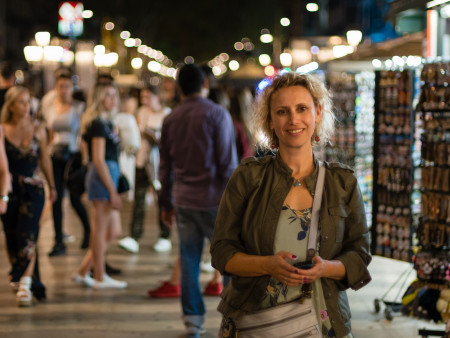
Dr Maria Relaki
Staff Tutor In Classical Studies


Biography
Professional biography
I graduated with a BA in Archaeology and History of Art from the Department of History and Archaeology at the National Kapodistrian University of Athens, Greece. I received my MA in Archaeology and Prehistory from the University of Sheffield. After working briefly for the archaeological service in Greece, I returned to Sheffield to study for my PhD. My thesis examined the socio-political context that led to the establishment of palatial culture during the Bronze Age in south-central Crete by exploring the tensions between tradition and change.
While I was working through a post-doctoral fellowship in Sheffield, investigating the ways material culture like ceramics can shed light on the spread of ideas and technical innovation across the different areas, I also started working as an Associate Lecturer at the Open University, at the Faculty of Arts and Humanities in 2007. Between 2017 and 2019 I was a Marie Sklodowska-Curie European Post-Doctoral Research Fellow, at the Université Catholique de Louvain, Belgium. My project was called House Poetics . It explored the materiality of human relations by examining how notions of kinship can only be constructed through spatial, temporal, and contextual associations with materials and objects.
I returned to the UK in 2019 and to teaching at the Open University, and also held a visiting research fellowship at the Institute of Greece, Rome, and Classical Tradition, at the University of Bristol. Between 2019 and 2002, I was a lecturer in Archaeology at the University of Sheffield. Alongside being an AL, I also held several fixed term positions as a Staff Tutor at the Department of Classical Studies at the Open University since 2021.
Research interests
Although my research has a geographical and chronological focus on the prehistoric Aegean and early historic Greece, its central themes are explicitly interdisciplinary and try to address the basic (but very hard to pin down!) question of how people’s everyday, small-scale interactions can have long-term and large-scale effects that amount to social change.Combining archaeology with anthropology, social theory, and philosophy, my main interest lies on how people make connections, particularly through less obvious ways. For instance, a large part of my research is about how dispersing objects and human remains across a cemetery helps construct a sense of shared space that is ultimately translated into kinship practices. In another, collaborative study, I explored how seemingly disparate technologies, such as bread making and pottery making use gestures and methods that are part of a shared technical regime which helped early Neolithic people construct a new understanding of being in the world. A lot of my research also focuses on the tensions that emerge when people try to combine their personal needs and perspectives with the collective identity of their communities. This has been the focus of two books I co-edited, An Archaeology of Land Ownership (2013) and OIKOS. Archaeological approaches to House Societies in Aegean Prehistory (2020) and has informed my work on gendered practices in antiquity. In my latest project I explore how the storytelling qualities of ancient myth can help us understand the role of techniques and technology in ancient and modern societies.
Teaching interests
As an AL I have taught the Level 1 modules Discovering the Arts and Humanities (A111), Cultures (A112) and the Level 3 modules The Roman Empire (A340), and Greek and Roman myths: stories and histories (A350). I also taught on the MA in Classical Studies, and co-authored module materials for A350. I am currently part of the production team of the new module The Roman Empire: People, Places, Power (A345).
Impact and Scholarship
I am passionate about spreading a love for all things archaeological to the wider public. I have run workshops and site visits for school children in Greece and the UK, and have given lectures to local societies and amateur archaeology groups.
In the context of my work in the Open University, I am also involved with employability initiatives and have contributed to several scholarship projects exploring employability and widening participation to work and study for graduate and post-graduate students. I have been the Assistant Reviews editor for the European Journal of Archaeology from 2019 until 2026, and I was recently appointed Deputy Editor-in-Chief.
Selected Publications
Books
Relaki, M. and J. Driessen (eds.) 2020. OIKOS. Archaeological approaches to House Societies in Aegean Prehistory. AEGIS Actes de colloques 19. Louvain-la-neuve: Presses universitaires de Louvain.
Relaki, M. and Y. Papadatos (eds.) 2018. From the Foundations to the Legacy of Minoan Archaeology. Studies in honour of Professor K. Branigan. Sheffield Studies in Aegean Archaeology 12. Oxford: Oxbow.
Relaki, M. and D. Catapoti (eds.) 2013. An Archaeology of Land Ownership. Routledge Studies in Archaeology 9. New York and London: Routledge.
Journal articles and book chapters in peer reviewed volumes
Single-authored
Relaki, M. 2023. Lady trouble? Body rituals and gender performance in Bronze Age Crete. In C. Langohr and Q. Letesson (eds.), Πολυμήχανος. Man of Many Ways. Papers in honour of Prof. Jan Driessen, pp. 177- 191. AEGIS 25. Louvain-la-Neuve: Presses universitaires de Louvain.
Relaki, M. 2020. Ecologies of care. Examining the practices of belonging in Bronze Age Crete. In M. Relaki and J. Driessen (eds.) OIKOS. Archaeological approaches to House societies in Aegean Prehistory, pp. 317-340. AEGIS Actes de colloques 19. Louvain-la-Neuve: Presses universitaires de Louvain.
Relaki, M. 2018. Roots and routes: Technologies of life, death, community and identity. In M. Relaki and Y. Papadatos (eds.), From the Foundations to the Legacy of Minoan Society. Studies in honour of Professor K. Branigan, pp. 10-35. Sheffield Studies in Aegean Archaeology 12. Oxford: Oxbow.
Relaki, M. 2013. Pervasive assumptions of ownership: land, gender and reproductive narratives. In M. Relaki and D. Catapoti (eds.), An Archaeology of Land Ownership, pp. 93-125. Routledge Studies in Archaeology 9. New York and London: Routledge.
Relaki, M. 2012. The Social Arenas of Tradition. Investigating corporate and individual social strategies in Prepalatial and Protopalatial Mesara. In I. Schoep, P.D. Tomkins and J. Driessen (eds.), Back to the beginning: Reassessing social and political complexity in Crete during the Early and Middle Bronze Age, pp. 290-321. Oxford: Oxbow.
Relaki, M. 2009. Rethinking administration and seal use in third millennium BC Crete. Creta Antica 10/II: 353-372.
Relaki, M. 2008. Community, Identity and Representation in Prepalatial and Protopalatial Mesara. Bulletin of the Institute of Classical Studies, 51: 187-188. London.
Relaki, M. 2004. Constructing a Region: the contested landscapes of Prepalatial Mesara. In J.C. Barrett and P. Halstead (eds.), The Emergence of Civilisation Revisited, pp. 170-188. Sheffield Studies in Aegean Archaeology 6. Oxford: Oxbow.
Co-authored
Catapoti, D. and M. Relaki 2021. “Fields of Discourse” revisited: a Simondonian perspective. In M. Boyd and R. Doonan (eds.), Far from equilibrium: an archaeology of energy, life and humanity. A response to the archaeology of John Barrett, pp. 201-220. Oxford: Oxbow books.
Catapoti, D. and Relaki, M., 2020. Why the Neolithic is (r)evolutionary. Journal of Material Culture 25(3): 259-288. https://doi.org/10.1177/1359183519894012
Relaki, M. and C. Tsoraki 2017. Variability and differentiation. A first look at the patterns of use and deposition of stone vases in the Petras cemetery. In M. Tsipopoulou (ed.), Petras Sitia: The Pre- and Proto-palatial cemetery in context, pp.159-178. Monographs of the Danish Institute of Athens, vol. 20. Aarhus: Aarhus University Press.
Catapoti, D. and M. Relaki 2013. An archaeology of land ownership: introducing the debate. In M. Relaki and D. Catapoti (eds.), An Archaeology of Land Ownership, pp. 1-20. Routledge Studies in Archaeology 9. New York and London: Routledge.
Day, P.M., M. Relaki and S. Todaro 2010. Living from pots? Ceramic perspectives on the economies of Prepalatial Crete. In D. Pullen (ed.), “Political Economies of the Bronze Age Aegean”, Proceedings of the Langford Conference held at FSU Tallahassee Florida, 22-24 February 2007, pp. 205-229. Oxford: Oxbow.
Day P.M., M. Relaki, and E. Faber 2006. Pottery making and social reproduction in Bronze Age Mesara, Crete. In M. H. Wiener, J. L. Warner, J. Polonsky and E. E. Hayes (eds.), Pottery and Society: The Impact of Recent Studies in Minoan Pottery. Gold Medal Colloquium in Honor of Philip P. Betancourt, 104th Annual Meeting of the Archaeological Institute of America, New Orleans, Louisiana, 5 January 2003, pp. 22-72. Boston: Archaeological Institute of America.
Day P.M. and M. Relaki 2002. Past factions and present fictions: palaces in the study of Minoan Crete. In J. Driessen, I. Schoep and R. Laffineur (eds.), Monuments of Minos. Rethinking the Minoan Palaces. Proceedings of the International Workshop held at the Université Catholique de Louvain, Louvain-La-Neuve, 14-15 December 2001, pp. 217-234. Aegaeum 23. Liège.
Book reviews
Relaki, M. (2021) On Palaces and Bulls. A review of Vance L. Watrous, ‘Minoan Crete: An introduction’. (Cambridge: Cambridge University Press, 2021, pp 240, £26.99, ISBN9781108440493). Argo. A Hellenic Review 14: 64-65.
Relaki, M. (2021) Review of David B. Small. ‘Ancient Greece: Social Structure and Evolution’ (Cambridge: Cambridge University Press, 2019, 284pp., 46 b/w illustr., 5 maps, pbk, ISBN 9780521719261). European Journal of Archaeology 24(2):273-277. DOI: 10.1017/eaa.2021.10


