

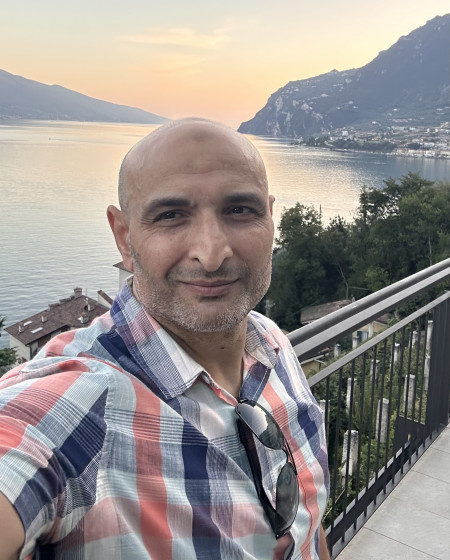
Dr Mohamed Bennasar
Lecturer In Computing & Communications
School of Computing & Communications
Biography
Biography
Professional biography
Mohamed Bennasar is a Lecturer in Artificial Intelligence in the School of Computing and Communications at the Open University. He holds a BSc in Computer Engineering and an MSc in Electronic Engineering from the University of Tripoli, and a PhD in Computer Engineering from Cardiff University. His doctoral research focused on developing a clinical decision support system for the early detection and diagnosis of dementia.
Following his PhD, Mohamed worked as a Research Associate at Cardiff University, investigating the use of wearable technology and machine learning to assess movement disorders. He joined the Open University as a Research Associate in 2017, working on technologies to support older adults’ health and wellbeing. After a lectureship at the University of Wales Trinity Saint David, he returned to the Open University as a Lecturer in 2022.
Research interests
Mohamed’s research focuses on artificial intelligence and machine learning, particularly their applications in healthcare, social care, and assistive technologies. His work includes feature selection, clinical decision support, human activity recognition, and the analysis of data from wearable and environmental sensors. He has collaborated with clinicians to develop methods for detecting dementia, assessing movement impairment in Huntington’s disease, and predicting outcomes in cardiac assessment.
At the Open University, Mohamed has investigated how intelligent systems can support older adults in their everyday lives. Through the STRETCH and SERVICE projects, his work has explored activity recognition, anomaly detection, and the prediction of loneliness using behavioural data. These projects bring together computing, psychology, and social care to develop technologies that respond to people’s practical and emotional needs.
Mohamed also leads the Face Recognition in the Wild project, combining AI methods with insights into human face perception, and leads the AI research team within the Acts of Care project. His wider research includes adaptive communication technologies for children with cerebral palsy, exploring how AI can support communication through multiple forms of interaction.
Teaching interests
Mohamed contributes to the Open University’s Artificial Intelligence module and postgraduate Digital Forensics module. His responsibilities include developing learning materials and designing assessments and examination questions. He contributed to the development of AI Module and is responsible for updating this module to reflect current research and advances in artificial intelligence. He is also developing a new Level 2 introductory module in artificial intelligence.
His teaching experience spans artificial intelligence, data analysis, programming, and computer engineering at undergraduate and postgraduate levels. He has also supervised undergraduate research projects and co-supervised doctoral research, particularly in the application of computing and machine learning to healthcare.
Publications
Book Chapter
Journal Article
Ability adaptive AAC: toward a modular, open-source framework (2026)
Predicting Loneliness Using Machine Learning and Self-Logged Behavioural Data (2025)
Towards Efficient AI Solutions for Facial Recognition in the Wild (2024)
Digital Intervention in Loneliness in Older Adults: Qualitative Analysis of User Studies (2023)
Significant Features for Human Activity Recognition Using Tri-Axial Accelerometers (2022)
Objectively characterizing Huntington's disease using a novel upper limb dexterity test. (2021)
Presentation / Conference
Towards Adaptive Multi-modal Augmentative and Alternative Communication for Children with CP (2024)
Presentation / Conference Contribution
Socio-Technical Resilience for Community Healthcare (2023)
How are you feeling? Using Tangibles to Log the Emotions of Older Adults (2020)
A Sensor Platform for Non-invasive Remote Monitoring of Older Adults in Real Time (2019)


