

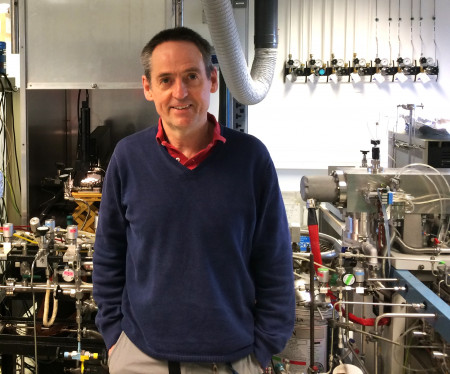
Dr Richard Greenwood
Senior Research Fellow
richard.c.greenwood@open.ac.uk
Biography
As a Senior Research Fellow in the Open University's School of Physical Sciences, I undertake detailed studies of meteorites and their constituent components (CAIs, chondrules, matrix phases). The principal aim of this work is to better understand the origin and early evolution of our Solar System.
Projects
Asteroids – Do look up!
STFC Public Engagement Nucleus Award 2024 Stage 2 For many school-aged students, space research is a subject far-removed from their daily lives. They may have heard of meteorites, cosmic dust, micrometeorites, meteors, shooting stars etc, but will almost certainly feel that these have little or no relevance to their own day-to-day experiences. Space rocks may be on display in national museums, but not in the classroom. Using a practical, hands-on approach, this project aims to dispel such misconceptions. The project will raise the “science capital” of the target group of students by bringing into their classrooms a range of extraterrestrial materials that they will then be able to interact with in a practical hands-on way. They will hunt for micrometeorites in their local area and analyze extraterrestrial samples using portable desk-top scanning electron microscopes available from both the Open University and the Natural History Museum. Each school involved in the project will have their own dedicated all-sky camera that will provide them with daily feedback on meteor and fireball activity in their local area. The participating schools will network to exchange samples, data and ideas. Based on recent experience elsewhere, this project will yield new extraterrestrial materials (“urban micrometeorites”) that the participating students will work with, and through this interaction develop a deeper, more profound understanding of key science areas. Through this practical experience, we seek to raise their “science capital”. Some of the new space materials that they discover will be analyzed at Diamond. This will provide the students with the opportunity to see a full science progression, from the initial discovery of new cosmic dust particles, characterization by optical and electron microscopy, to analysis using sophisticated apparatus, such as Diamond. This journey for the students will be exciting and provide a unique insight into how real science works.
Correlated microanalysis in the sample return era: Organics and volatiles in planetary building blocks and their delivery to early Earth
This funding bid is an application to the Royal Society International Exchange Scheme - Cost Share Programme 2022 for funds to facilitate scientific exchange visits with the Kochi Institute in Japan.
Preparing for Mars Sample Return: Training the next generation in precise, spatially resolved, oxygen isotope analysis
Samples of Martian origin will be returned to Earth via JAXA’s MMX mission in about six years from now (2029), with Mars surface-collected materials returned to Earth by the NASA/ESA MSR collaboration in about ten years’ time (2033). The timescale involved, particularly for participation in MMX, are tight and action is needed now to ensure that the UK science community is ready to play a full role in the analysis of these precious materials. Appropriate action is required on a number of fronts. We need to be ready in terms of having suitably trained scientists with a relevant expertise in cutting edge analysis techniques relevant to the characterization of Martian samples. We need to maintain and enhance the capabilities of our world-leading analytical facilities that are essential to the analysis of Martian samples. These facilities will provide the scientific leverage required to be part of any initial analysis initiative. And critically, we need to be able to demonstrate to our partner space agencies that we have the appropriate clean handling facilities and preparation techniques relevant to the manipulation of pristine returned samples. This proposal sets out in detail a framework for addressing these issues by providing a PhD opportunity to undertake a cutting-edge oxygen isotope study by laser assisted- fluorination of Martian meteorite samples. The samples that will be analyzed are closely aligned to the composition of the materials already collected and cached by the Perseverance Rover. Oxygen isotope analysis by laser fluorination is a key Martian analysis technique in which the UK is the world-leader. The scientific outputs from this study are critical to understanding the evolution and interactions between the Martian hydrosphere, lithosphere and atmosphere. This work needs to be completed in advance of initial sample return in order to maximize the scientific outputs once the main phase of characterization work commences. This study will not only train a new Mars sample specialist, but will help to sustain and develop our leadership role in Mars critical laser fluorination analysis. In addition, this will provide benefits for the wider UK extraterrestrial analysis community through rapid allocation of returned Mars material, as was the case for asteroidal particles returned by the JAXA Hayabusa2 mission. We will also be obtaining an early allocation in the upcoming NASA OSIRIS-REx initial analysis phase (October 2023). As a consequence of our involvement in these missions, we have developed a range of clean sample manipulation techniques. These will be further developed during the course of this study. The technical expertise and hardware products developed during this project will be disseminated to other groups within the UK analysis community. By making this specialist expertise more widely available we will provide a competitive advantage to other UK-based researchers seeking to bid for pristine returned samples.
Funding bid to purchase two secure cabinets to display meteorite specimens.
This bid is for approximately £3,000 from the Meteoritical Society Endowment Fund to purchase two secure display cabinets. These cabinets will showcase museum grade meteorite specimens. The cabinets will form an important resource for future outreach activities. The ability to display high-quality meteorite samples will assist in our efforts to obtain more substantial funding for our ongoing outreach activities.
STFC Open 2018 DTP
STFC Open 2018 DTP
Publications
Journal Article
Crossing boundaries: Brachinites and their diverse asteroidal origins (2026)
The Noritic mineralogy of V- and S-type objects and the links with asteroid (4) Vesta (2026)
The diversity, classification, and formation of the CM chondrite group: A review (2025)
The variety and origin of materials accreted by Bennu’s parent asteroid (2025)
Northwest Africa 4269: a metal-rich eucrite from the Algerian Sahara (2025)
Matera: A not so ordinary H5 chondrite breccia with very low density and high porosity (2025)
Mineralogical evidence for hydrothermal alteration of Bennu samples (2025)
Northwest Africa 13489: A Strongly Metamorphosed Ungrouped Carbonaceous Chondrite (2025)
The mystery of the missing mantle problem and insights from spectroscopy (2025)
Remnants of a lost Planetesimal: Searching for the Angrite parent body (2025)
Phosphorus-rich grains in Ryugu samples with major biochemical potential (2024)
Isotopic evidence for a common parent body of IIG and IIAB iron meteorites (2024)
Evidence against water delivery by impacts within 10 million years of planetesimal formation (2024)
Asteroid (101955) Bennu in the laboratory: Properties of the sample collected by OSIRIS ‐ REx (2024)
A mineralogical and isotopic study of the historic monomict eucrite Padvarninkai (2024)
The primary abundance of chondrules in CI chondrites (2024)
Quantitative evolved gas analysis: Winchcombe in comparison with other CM2 meteorites (2024)
Recovery and curation of the Winchcombe (CM2) meteorite (2024)
How many Vesta‐like bodies existed in the asteroid belt? (2024)
A primordial noble gas component discovered in the Ryugu asteroid and its implications (2024)
The impact history and prolonged magmatism of the angrite parent body (2024)
Petrology and shock history of the first depleted‐like poikilitic shergottite Asuka 12325 (2023)
Determining the Pyroxene Mineralogies of Vestoids (2023)
The Winchcombe meteorite—A regolith breccia from a rubble pile CM chondrite asteroid (2023)
Insight into multi-step geological evolution of C-type asteroids from Ryugu particles (2023)
Oxygen isotope evidence from Ryugu samples for early water delivery to Earth by CI chondrites (2023)
Early fluid activity on Ryugu inferred by isotopic analyses of carbonates and magnetite (2023)
A history of mild shocks experienced by the regolith particles on hydrated asteroid Ryugu (2023)
A pristine record of outer Solar System materials from asteroid Ryugu’s returned sample (2022)
The Winchcombe meteorite, a unique and pristine witness from the outer solar system (2022)
The Loongana (CL) group of carbonaceous chondrites (2021)
Eucrite‐type achondrites: Petrology and oxygen isotope compositions (2021)
Tintigny meteorite: The first Belgian achondrite (2021)
Xenoliths in ordinary chondrites and ureilites: Implications for early solar system dynamics (2021)
Terrestrial Alteration Mineral Assemblages in the NWA 10416 Olivine Phyric Shergottite (2020)
Linking asteroids and meteorites to the primordial planetesimal population (2020)
Cosmic spherules from Widerøefjellet, Sør Rondane Mountains (East Antarctica) (2020)
The Piancaldoli meteorite: A forgotten primitive LL 3.1 ordinary chondrite (2020)
Oxygen isotopes and sampling of the solar system (2020)
Geochemistry and Sm‐Nd chronology of a Stannern‐group eucrite, Northwest Africa 7188 (2019)
The diversity of CM carbonaceous chondrite parent bodies explored using Lewis Cliff 85311 (2019)
Carbonaceous matter in the Sariçiçek meteorite (2019)
A novel organic-rich meteoritic clast from the outer solar system (2019)
Ejby—A new H5/6 ordinary chondrite fall in Copenhagen, Denmark (2019)
Experimental insights into Stannern‐trend eucrite petrogenesis (2018)
A mutli-technique search for the most primitive CO chondrites (2018)
Bunburra Rockhole: Exploring the geology of a new differentiated asteroid (2017)
The mineralogy, petrology, and composition of anomalous eucrite Emmaville (2017)
The Braunschweig meteorite − a recent L6 chondrite fall in Germany (2017)
The abundance and isotopic composition of water in eucrites (2016)
Triple oxygen isotopic composition of the high-3He/4He mantle (2016)
Cosmochemical and spectroscopic properties of Northwest Africa 7325 - A consortium study (2016)
The Vicência meteorite fall: A new unshocked (S1) weakly metamorphosed (3.2) LL chondrite (2015)
A water–ice rich minor body from the early Solar System: The CR chondrite parent asteroid (2014)
The Danebury Iron Age meteorite—An H5 ordinary chondrite “find” from Hampshire, England (2014)
The Paris meteorite, the least altered CM chondrite so far (2014)
The Wabar impact craters, Saudi Arabia, revisited (2013)
Light element geochemistry of the Chelyabinsk meteorite (2013)
Tissint martian meteorite: a fresh look at the interior, surface, and atmosphere of Mars (2012)
Jiddat al Harasis 556: A howardite impact melt breccia with an H chondrite component (2012)
Late Accretion on the Earliest Planetesimals Revealed by the Highly Siderophile Elements (2012)
Evolution MegaLab: a case study in citizen science methods (2012)
The Australian Desert Fireball Network: a new era for planetary science (2012)
Maribo-A new CM fall from Denmark (2012)
Petrology and geochemistry of the Northwest Africa 3368 eucrite (2011)
Jiddat al Harasis 422: a ureilite with an extremely high degree of shock melting (2011)
The relationship between CK and CV chondrites (2010)
Trace element geochemistry of K-rich impact spherules from howardites (2009)
The Puerto Lápice eucrite (2009)
The Fountain Hills unique CB chondrite: Insights into thermal processes on the CB parent body (2009)
An anomalous basaltic meteorite from the innermost main belt (2009)
Crustal partial melting on Vesta: evidence from highly metamorphosed eucrites (2009)
The petrology and geochemistry of Miller Range 05035: A new lunar gabbroic meteorite (2008)
Geochemistry of diogenites: still more diversity in their parental melts (2008)
Petrographic classification of Middle Ordovician fossil meteorites from Sweden (2007)
Oxygen isotope variation in stony-iron meteorites (2006)
Widespread magma oceans on asteroidal bodies in the early Solar System (2005)
Alteration and metamorphism of CO3 chondrites: evidence from oxygen and carbon isotopes (2004)
Pinpointing the source of a lunar meteorite: implications for the evolution of the moon (2004)
Further characterisation of the 91500 Zircon Crystal (2004)
An isotopic and petrologic study of calcium-aluminum-rich inclusions from CO3 meteorites (1998)
Formation and alteration of CAIs in Cold Bokkeveld (CM2) (1994)
Petrogenesis of the gabbros from Mt. St. Hilaire, Quebec, Canada (1984)
Other
Presentation / Conference
A Detailed Mineralogical and Isotopic Study of the Historic Monomict Eucrite Padvarninkai (2022)
NWA 10989 – A New Lunar Meteorite with Equal Proportions of Feldspathic and VLT Material (2017)
Mineralogy and petrology of the Murrili meteorite (2016)
Northwest Africa 10639 and 10640: Two new monomict eucrites from Sahara (2016)
Chlorine isotope variation in eucrites (2016)
NWA 10659: A CLAY-RICH NAKHLITE PAIR OF NWA 10153 (2016)
Oxygen isotopes and origin of opal in an Antarctic ureilite (2016)
C chondrite clasts in H chondrite regolith breccias: something different (2016)
Northwest Africa 10319 and 10320: two new cumulate eucrites from Sahara (2016)
Textural and minerochemical features of Dar al Gani 1067, a new CK chondrite from Libya (2016)
Continuing the search for the most primitive CO chondrites: The oxygen isotope perspective (2016)
Pyroxene-plagioclase pallasite Northwest Africa 10019: Where does it belong? (2016)
Enon and Puente del Zacate: A duo of primitive-silicate-bearing magmatic irons (2016)
Iron and oxygen isotope fractionation during photo-oxidation (2016)
Origin of opal (hydrated silica) in polymict ureilites (2016)
Choteau makes three: A characterization of the third member of the Vermillion subgroup (2016)
The isotopic composition of chlorine in apatite from eucrites (2016)
Petrologic and oxygen-isotopic investigations of eucritic and anomalous mafic achondrites (2016)
Combined chemical-oxygen isotope study of large igneous inclusions in ordinary chondrites (2016)
The Mineralogy and Petrology of Anomalous Eucrite Emmaville (2015)
Fluid migration on early-accreting planetesimals (2015)
The abundance and isotopic composition of water in howardite-eucrite-diogenite meteorites (2014)
Bunburra Rockhole: Exploring the geology of a new differentiated basaltic asteroid (2014)
Understanding early Solar System processes: an oxygen isotope perspective (2011)
Widespread evidence for heterogeneous accretion of the terrestrial planets and planetisimals (2011)
Origin of the ungrouped achondrite NWA 4518: mineralogy and geochemistry of FeNi-metal (2011)
NWA 6356: unequilibrated polymict ureilite (2011)
NWA 4537: A new Aubrite from northwest Africa (2010)
NWA 4415 AND 4416: Two new enstatite chondrites from northwest Africa (2010)
Northwest Africa 5790. Top Sequence of the Nakhlite Pile (2010)
Widespread evidence for a late veneer on the terrestrial planets and planetisimals (2010)
RBT 04133: a new, unusual carbonaceous chondrite (2009)
Impact histories of Vesta and Vestoids inferred from howardites, eucrites and diogenites (2009)
NWA 4477: A unique impact melt breccia (2009)
NWA 4418: A new mesosiderite from Northwest Africa (2009)
Textural and compositional features of NWA 4222, A new Martian meteorite (2009)
Carbon and nitrogen cosmochemistry of the CO3 group (2008)
Oxygen Isotopic Constraints on the Number and Origin of Basaltic Achondrite Parent Bodies (2008)
The Meteorite Fall in Carancas, Lake Titicaca Region, Southern Peru: First Results (2008)
Tafassasset: The Saga Continues (2008)
Mineralogy and Geochemistry of Shergottite RBT 04262 (2008)
Reflectance spectra of Mesosiderites: Implications for asteroid 4 Vesta (2007)
Oxygen isotope composition of the primitive Achondrites (2007)
The Moss (CO3) meteorite: an integrated isotopic, organic and mineralogical study (2007)
Organic constitution of the CO3 chondrites and implications for asteroidal processes (2007)
The rocks from space initiative and the space safari (2007)
Could Stannern-trend eucrites be crustal-contaminated melts? (2007)
Experimental study of laboratory-heated CM2 chondrites Mighei and Murchison (2006)
New oxygen isotope evidence for the origin of mesosiderites and main group pallasites (2006)
A new CK carbonaceous chondrite from Hammada Al Hamra, Libya (2006)
A new CO carbonaceous chondrite from Acfer, Algeria (2006)
A new CH carbonaceous chondrite from Acfer, Algeria (2006)
Amino acids composition and oxygen isotopes in the Shisr 033 CR chondrite (2005)
High-temperature chemical processing on asteroids: An oxygen isotope perspective (2005)
Oxygen isotopic variation of asteroidal materials (2005)
The Diderot meteorite: The second chassignite (2005)
The Fountain Hills meteorite: A new CBa chondrite from Arizona (2004)
Oxygen isotopic variation of the terrestrial planets (2004)
The relationship between CK and CV chondrites: a single parent body source? (2004)
Oxygen isotope evidence for the origin of HEDs and Angrites (2003)
Are CK chondrites really a distinct group or just equilibrated CVs? (2003)


