

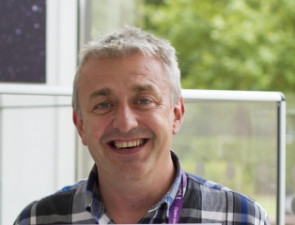
Dr Simon Sheridan
Senior Research Fellow
Biography
Research interests
My research interests include the design, development, and operation of instrumentation to aid the understanding of the chemical composition of Solar System bodies. I am particularly interested in the characterisation of volatiles contained in the lunar regolith, and their application to In-Situ Resource Utilisation (ISRU). Currently, I am the science lead developing the EMS-L mass spectrometer for the JAXA LUPEX mission which will measure volatiles released from excavated sub-surface materials at the south pole of the moon in 2028.
Teaching interests
I am passionate about teaching and currently serve as Co-Chair of Y033, the Open Universities STEM Access course that introduces students to university study and prepares them for studying STEM subjects at degree level. I am also an Associate Lecturer for the SPS288 Remote Experiments in Physics and Space, the Open Universities practical science module that includes remote experiments in astronomy, physics and planetary Science
Impact and engagement
I am a passionate STEM ambassador, and enjoy interacting with local school, exhibitions, and the media. Some highlights include:
- ESERO-UK Tim Peake Primary Project (TPPP) Space Ambassador
- ESERO-UK Polar Ambassador
- Interviews on national television and radio including the Sky at Night and
- Delivering space related CPD to primary school STEM teachers
- Delivering public talks
- Delivering enrichment sessions for local schools
Projects
ProSPA: a lunar exploration science payload
The OU is leading the development of ProSPA, a miniature chemical laboratory for analysing samples for water and ice at the Moon. Together with the ProSEED drill, it makes up PROSPECT, the European Space Agency’s lunar sampling and analysis package. PROSPECT will fly on the Intuitive Machines-4 mission procured by NASA, landing near the south pole of the Moon to survey how water and other molecules are distributed on and under the Moon’s surface. It will help us understand where these materials came from, how they are processed under lunar conditions, and whether they might be harvested as useful resources. The OU is partnered in UK by RAL Space, Airbus Defence and Space, and Dynamic Imaging Analytics; in Germany we work with Max Planck Institute for Solar System Research and Technical University of Munich. PROSPECT is led by Leonardo S.p.A. (Italy) under a programme of and funded by ESA.
ProSPA CD CCN14 CLPS Conversion - Phase C/D1
THIS AMS PROJECT IS A CONTRACT CHANGE NOTICE (CCN) TO AMS PROJECT(688076) ProSPA Phase C/D [E-00070]-01 F5304]. THIS CCN PROVIDES ADDITIONAL INCOME TO OU, TO COVER THE LONGER PROJECT TIMESCALE THAT HAS RESULTED FROM THE CHANGE OF THE SPACECRAFT PROVIDER FROM RUSSIA TO NASA BECAUSE OF EVENTS IN UKRAINE. NO ADDITIONAL OBLIGATIONS ARE PLACED ON OU AS A RESULT OF THIS CCN: 1) It recovers 100% of the additional OU staff costs required 2) It recovers 100% of the additional OU non-staff costs required 3) It recovers 100% of the additional External Partner costs.
MAGPIE Phase A (CCN to original contract)
The objective of this CCN is to extend the MAGPIE project into Phase 1
Exploration Mass Spectrometer for LUPEX - CCN1
In the frame of the EMS-LUPEX program, JAXA have confirmed their need to use the EMS-LUPEX ETM until the end of the mission (see EMS-L PDR MoM EMS-LMM-107, section JAXA-ESA-KI Management Meeting – 18/12/2024). The Agency therefore requests to activate the EMS-L re-flight option (Mandatory Option in the Contract)
Exospheric Mass Spectrometer (EMS) Development
EMS – the Exospheric Mass Spectrometer – was a spinout of the OU’s ProSPA development programme and flew on NASA’s first attempt to land on the Moon under the Artemis program. As the sensor within the PITMS (Peregrine Ion Trap Mass Spectromer) payload, it aimed to study how a lunar water cycle might be driven by the hot daytime and cold night-time temperatures of the Moon’s surface. And how over millions of years this may contribute to vast stores of water and other molecules at permanently cold polar regions – molecules that could tell us the history of our own planet and might support human exploration of the solar system. The OU, partnered by RAL Space and funded by ESA, developed the Exospheric Mass Spectrometer for PITMS and supported its in-flight scientific operations before the mission ended prematurely after a fault with the spacecraft’s propulsion system. The PITMS instrument was led by Dr Barbara Cohen at NASA Goddard Space Flight Center.
GC Connect: Gas Chromatography components and their fluidic electrical CONNECTionsions
ESA project to develop MEMS Gas Chromatography components for space flight instrumentation. This is a follow on project for the MEMS GC-MS, AMS project 658840
DAMS Prototype (DAMS follow on study) (SM-10-041-GM)
Following on from the CAMS Replacement Feasibilty Study, the OU has been invited to propose a 17 month project to build a Prototype replacement system. The Distributed Air Monitoring System (DAMS) Prototype will be made available for a BAe submarine trial in August 2010. Final Reports and submarine Trial reports are due to be available before November 2010. A MOD decision will be made after November 2010 as to whether the DAMS system will be adopted as a replacement for CAMS.
ExoMars Follow On Instrument Development. (SM-09-083-SS)
Of particular interest to the PSSRI are missions that offer the opportunity to gain access to surface and sub-surface material through the deployment of mass spectrometers from either high-speed penetrator platforms or from sub-surface penetrating mole devices deployed by soft landers. We plan to develop and evaluate a non-destructive ion detection system for an Ion trap mass spectrometer which can be deployed by either a penetrator or a mole deployment device. A mass spectrum can be extracted from an image current measured at a number of pick-up plates by performing a Fourier Transform (FT) on the measured image current. Thus, FT detection offers the unique ability to detect all of the trapped ions simultaneously and with sufficiently high sampling rates extremely high resolution measurements are possible. In addition, the non-destructive nature of FT detection offers the ability to measure a trapped ion population many times, thus increasing detector integration durations, resulting in very high instrument sensitivity. It is anticipated that such an instrument will have analytical (mass resolution, sensitivity) and systematic (i.e. mass and power) advantages over current technology Targeted initially at space flight applications, the study will also consider its applicability to laboratory-based isotope geochemistry.
Lunar Volatiles Mobile Instrument
Lunar Volatiles
STFC-RCUK Innovation Fellow - Valve Exploitation
STFC/RCUK Innovation Fellowship
Understanding attenuation of UHF by regolith for penetrator missions
‘Penetrators’ are a new kind of spacecraft that land at high speed (think bullet from a gun!) into a planetary body such as the Moon, Mars or Europa, burying themselves a few meters into the ground in the process. Because they land at high speed, they don’t need much fuel to slow themselves down before hitting the surface – which means that the missions can be lightweight – which also means inexpensive. And here’s the clever bit: they contain a suite of sensors that operate during and after the landing, taking a host of scientific measurements such as the structure of the material into which they have landed, its temperature and chemical composition – even photos of the landing site. Many scientists – us included – think the best place to land the first penetrator mission would be near the south pole of the Moon. This has never been visited before, because it is very cold and there is very little sunlight to power the solar cells needed to keep a traditional Moon lander or rover alive. In fact, some places are so cold that we believe that valuable materials such as water ice may have collected there over billions of years in a gigantic deep freeze, holding clues about how the Moon formed and evolved. Not only is this of tremendous scientific value, it also changes the way we think about exploring the Moon and even our solar system. If we can find this water it opens up the possibility of using it to supply astronauts in future Moon bases with drinking water. And then we can split it into hydrogen and oxygen to fuel a new fleet of spacecraft that could take advantage of the Moon’s low gravity to launch new missions to Mars and beyond. This study is a vital step in designing a penetrator mission. We want to study how the radio signal that it transmits after landing, is affected by the soil it is buried beneath. If we find that the signal passes easily through the soil, we can design the penetrator to go deeper so it can achieve more science. If the signal doesn’t pass easily, then we will design a shallower penetrator. The ideal experiment would test a radio signal passing through real lunar soil. But to do this would require a lot of soil – much more than we could obtain of the precious samples brought back to Earth by NASA’s Apollo missions. And there’s another problem – all the samples on Earth are from near the Moon’s equator, meaning it is very different to what we would expect to find near the pole. So our first step will be to identify a suitable lunar soil ‘analogue’ – an Earth rock that has been crushed to mimic the essential properties of the Moon’s polar soil. Then we will mix it with varying proportions of water ice, and cool it to a range of sub-zero temperatures, to mimic the conditions at the lunar poles. And finally we can obtain a suite of measurements of the electrical properties of the soil, which we can feed into a computer model to predict how our penetrator antenna will perform when buried on the Moon. This research will be performed by The Open University partnered by QinetiQ Limited, and you can follow our progress at www.spacelabslive.com
The Valve : A Solution for Satellite Propulsion (HTP)
Recent discussions with the Satellite Propulsion Group at SSTL Ltd have resulted in them rating the development, qualification and implemention of the OU's patented proportional valve as being their strategic R&D priority for 2015. Simon Sheridan is the lead inventor the patent (The Valve) along with Martin Jarvis and Geraint Morgan. Oli Lane from SSTL will lead a bid to Innovate UK that will use the OU as their academic project partners to translate the exisiting know-how to SSTL. A second commercial company (tank manufacturer) may also form part of the application (tbc). A commercial Licensing Deal between the OU and SSTL will be a pre-requisite for the work to go ahead. Meetings are scheduled with Malcolm Stokes and iain Gilmour to further this agenda. With SSTL being a subsidiary of Airbus - derivatives of the OU valves have the potential to be utlised as part of the propulsion systems on future small and large (including geostationary) satellites. SSTL would provide the route to market and would conduct the necessary space qualification. Budget available to the OU is likely to be 80% of £80k (tbc)
Publications
Book Chapter
Planning for engaged research: a collaborative ‘Labcast’ (2017)
Application of penetrators within the solar system (2010)
Ptolemy - a GCMS to measure the chemical and stable isotopic composition of a comet (2009)
Journal Article
Water extraction from icy lunar simulants using low power microwave heating (2023)
Water extraction from icy lunar simulants using low power microwave heating (2023)
A quantitative evolved gas analysis for extra-terrestrial samples (2020)
Searching for potential ice-rich mining sites on the Moon with the Lunar Volatiles Scout (2020)
Scientific rationale for Uranus and Neptune in situ explorations (2018)
On the attempts to measure water (and other volatiles) directly at the surface of a comet (2017)
The Hera Saturn entry probe mission (2016)
Subsurface characterization of 67P/Churyumov–Gerasimenko's Abydos site (2016)
Ptolemy operations at the surface of a comet, from planning to reality (2016)
Cometary isotopic measurments (2015)
CHO-bearing organic compounds at the surface of 67P/Churyumov-Gerasimenko revealed by Ptolemy (2015)
L-VRAP-a lunar volatile resources analysis package for lunar exploration (2012)
Ptolemy operations and results during the Lutetia flyby (2012)
The Rosetta campaign to detect an exosphere at Lutetia (2012)
Lunar Net - a proposal in response to an ESA M3 call in 2010 for a medium sized mission (2012)
Penetrators for in situ subsurface investigations of Europa (2011)
LunarEX: a proposal to cosmic vision (2009)
A small mission for in situ exploration of a primitive binary near-Earth asteroid (2009)
Laboratory optimization of the Helium Carrier Gas Flow System of MODULUS Ptolemy (2009)
Patent
Presentation / Conference
Water Extraction from Icy Lunar Simulants using Low Power Microwave Heating (2022)
Modelling Dust Clouds Produced from Lunar Rover Operations (2022)
Development of Enceladus ice analogues for in situ analysis (2021)
LUVMI-X: A Versatile Platform for Resource Prospecting on the Moon (2021)
Characterisation of the LUVMI Lunar Volatiles Scout Instrument (2020)
LUVMI Rover to Characterise Volatile Content in Lunar Polar Regions (2019)
Mass Spectrometers for In-Situ Resource Utilisation (2019)
Lunar Volatiles Mobile Instrumentation (LUVMI) Project Results (2019)
Volatile Characterisation Instrumentation for ISRU applications (2019)
In-Situ Studies of the Lunar Water Cycle by Ion Trap Mass Spectrometry (2019)
Water Production from Lunar Samples and Simulants (2019)
Characterization of the Lunar Volatiles Scout for In-Situ Volatiles Extraction and Analysis (2019)
Characterisation of the LUVMI Volatile Extraction and Volatiles Analysis package (2019)
Europe's future exploration of Main Belt Comets (2018)
Penetrators as a deployment tool for Mass Spectrometer instrumentation (2018)
Hydrogen Reduction of Ilmenite in a Static System for a Lunar ISRU Demonstration (2018)
Low Cost Proportional Valves for Electric Propulsion using Piezoelectric Actuators (2018)
ProSPA: Analysis of Lunar Polar Volatiles and ISRU Demonstration on the Moon (2018)
Penetrator-deployed mass spectrometers for volatiles analysis at the Moon (2018)
Mobile In-Situ Exploration of Lunar Volatiles with the LVS on LUVMI (2018)
L-DART: A Penetrator Mission for Lunar Permanently Shadowed Regions (2018)
High Speed Penetrator Deployed Mass Spectrometers (2017)
LUVMI – Volatile Extraction and Measurements in Lunar Polar Regions (2017)
PROSPECTing for Lunar Polar Volatiles: the ProSPA Miniature In-situ Science Laboratory (2017)
LUVMI: an innovative payload for the sampling of volatiles at the Lunar poles (2017)
Hydrogen reduction of ilmenite as an ISRU demonstration for ProSPA (2017)
A Penetrator deployed Mass Spectrometer for Akon (2016)
Characterization of the Subsurface of 67P/Churyumov-Gerasimenko's Abydos Site (2015)
Rosetta: The Final Furlong (2015)
The Hera Entry Probe Mission to Saturn, an ESA M-Class mission proposal (2015)
Evolution of the subsurface of 67P/Churyumov-Gerasimenko’s Abydos Site (2015)
ProsPA: A miniature chemical laboratory for in-situ assessment of lunar volatile resources (2015)
First measurements of the surface composition of 67P using the Ptolemy mass spectrometer (2015)
Containers, sensors and samples to understand desert weathering (2015)
Accessing and assessing lunar resources with PROSPECT (2014)
The operational plans for Ptolemy during the Rosetta mission (2014)
In Situ Science and Instrumentation for Primitive Bodies (2013)
In situ cometary cosmochemistry (2013)
Ptolemy: preparations for scientific investigations at the surface of a comet (2013)
Spacecraft health and environmental monitoring from a CubeSat platform (2012)
Ptolemy: operations to date as part of the Rosetta mission and plans for the comet encounter (2012)
An astrobiology payload complement for a Europa Penetrator (2012)
Rosetta - ESA's comet lander mission (2012)
A Penetrator deployed sub-surface volatile mass spectrometer (2012)
A mole deployed mass spectrometer for in-situ sub-surface volatile characterisation (2012)
Ptolemy: operations at 21 Lutetia as part of the Rosetta mission and future implications (2012)
The Lunar Volatile Resources Analysis Package (2012)
Searching for lunar water: the Lunar Volatile Resources Analysis Package (2012)
The ESA Lunar Lander and the search for Lunar Volatiles (2011)
ESA lunar lander's search for volatiles (2011)
Asteroidal atmospheres: a new subject area (2011)
In situ analytical chemistry for the future exploration of Titan (2010)
Quantification of ethyl acetate using FAIMS (2010)
Isotope measurements of a comet by the Ptolemy instrument on Rosetta (2010)
Ptolemy operations in anticipation of the flyby of asteroid 21 Lutetia (2010)
Lunar science below the surface - the MoonLITE Low Cost Penetrator Mission (2009)
A penetrator deployed biogeochemistry package for the Europan surface (2009)
Investigating TriHaloMethanes with respect to humidity (2009)
Isotope measurements of a comet by the Ptolemy instrument on Rosetta (2009)
MoonLITE programmatic and technological update (2009)
MoonLITE – Technological feasibility of the penetrator concept (2008)
Miniaturised mass spectrometery for future space flight applications (2007)
Kinetic penetrators for exploration of solar system bodies (2007)
Integrated sampling and mass spectrometer systems for Venus probe and balloon missions (2006)
Beagle 2: Mission to Mars — current status (2004)
In-situ chemical and isotopic analysis of a comet by Ptolemy (2003)


