

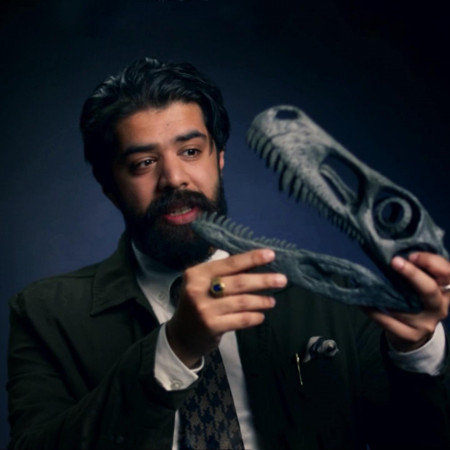
Dr Suresh Singh
Post Doctoral Research Associate, Saber
School of Environment, Earth & Ecosystem Sciences


Biography
I study the links between morphology, ecology and evolution across deep time, with a focus on terrestrial tetrapods and ecosystems. My research explores how different forces shaped evolution and biodiversity patterns through Earth's history, with a particular focus on understanding the impacts of ecological interactions, both among animals and between animals and their environments, over geological timescales. I work at the intersection of functional morphology, ecology and macroevolution, using a combination of morphometric, macroecological and phylogenetic comparative approaches.
My current research with SABER focuses on investigating macroevolutionary drivers and diversification dynamics in South America through the Cenozoic to understand the origins of the modern Amazonian biodiversity hotspot. However, my broader research includes macroevolutionary and palaeoecological studies of terrestrial tetrapods through the Palaeozoic and Mesozoic.
I am particularly interestred in:
- Non-mammalian synapsids
- Early dinosaurs
- Early tetrapods
- Mass extinctions
- Terrestrial ecosystem evolution
- Functional morphology
- Palaeoecology
- Palaeogeography
I'm also a keen advocate for public science communication and outreach. As well as delivering in-person natural history and science workshops in schools, museums and festivals, I have acted a scientific consultant on television documentary series for the BBC (Earth) and Netflix (The Dinosaurs), as well as popular science podcasts such as 'The Backpackers Guide to Prehistory' and Palaeocast. I've also contributed to several popular science articles for BBC Futures, The Economist and The New Scientist.
Featured Publications:
- Warshaw, E. A., Singh, S. A., & Benton, M. J. (2026). Trophic ecology outweighed intrinsic constraints in shaping skull evolution of carnivorous Permian synapsids. Communications Biology.
- Singh, S. A., Elsler, A., Stubbs, T. L., Rayfield, E. J., & Benton, M. J. (2024). Predatory synapsid ecomorphology signals growing dynamism of late Palaeozoic terrestrial ecosystems. Communications Biology, 7(1), 201.
- Shipley, A. E., Elsler, A., Singh, S. A., Stubbs, T. L., & Benton, M. J. (2024). Locomotion and the early Mesozoic success of Archosauromorpha. Royal Society Open Science, 11(2).
- Huttenlocker, A. K., Singh, S. A., Henrici, A. C., & Sumida, S. S. (2021). A Carboniferous synapsid with caniniform teeth and a reappraisal of mandibular size-shape heterodonty in the origin of mammals. Royal Society open science, 8(12).
- Singh, S. A., Elsler, A., Stubbs, T. L., Bond, R., Rayfield, E. J., & Benton, M. J. (2021). Niche partitioning shaped herbivore macroevolution through the early Mesozoic. Nature Communications, 12(1), 2796.
Further Research Links:


