

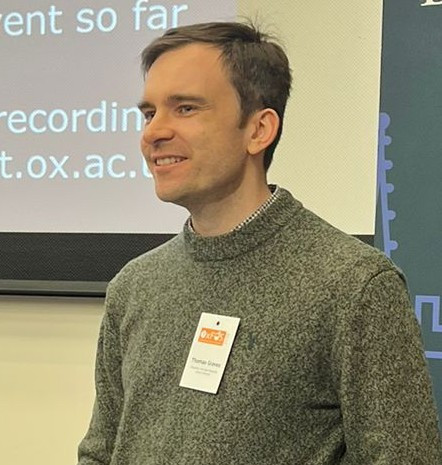
Dr Thomas Graves
Lecturer In Music




Biography
Professional Biography
Thomas Graves joined the Open University on a one-year contract as a Lecturer in Music in September 2026. Previously, he taught "world music traditions" at Durham University on a part-time basis, and worked in the library at London School of Economics supporting the Open Research Community there, where he also founded the nascent LSE Music Research Network. In 2024, he completed a PhD in Ethnomusicology/Music Psychology at Durham University for a thesis exploring the emotional experiences of listeners to qawwali at the tomb complexes of Sufi saints in India. Prior to his doctoral research, he completed a master's in ethnomusicology at SOAS, University of London, and a bachelor's degree in Popular Music at the University of Kent.
Research Interests
Thomas's research interests primarily focus on qawwali, the most popular Sufi music of South Asia. His research has combined ethnographic approaches with the quantitative approaches of music psychology, seeking to embed quantitative studies of the labelling of subjective feeling, mechanisms of musical emotion, and Quantity of Motion within a broader ethnographic and musical context, highlighting the moral and spiritual thoughtworld in which those emotions become meaningful. He has published on subjective feeling categories in qawwali listening, the solidaristic emotional role of YouTube comments on qawwali videos, the role of music in interfaith friendship, and the rhetoric of death in qawwali lyrics and Sufi ritual.
Currently, he is collaborating with his singing teacher, the Hindustani singer and music historian Dr Budhaditya Bhattacharyya, in a project exploring which raga is assigned to the famous qawwali "Man Kunto Maula". He is also developing his argument for a more unified "anthromusicology", and plans to conduct future research into the relationship between qawwali and cultural institutions which are increasingly supporting it.
More generally, his topics of interest are:
- Qawwali
- South Asian Musics (particularly of North India and Pakistan)
- Music and Emotion
- Music and Islam
- Music and Cultural Institutions
- Music and Politics
- The Moral Anthropology of Musical Emotion
- Questions of disciplinarity, epistemology, and methodology in music research
Teaching Interests
At the Open University, Thomas is involved in teaching:
- A891 MA Music Part 2
- A890 MA Music Part 1
- A234 Understanding Music
Elsewhere, he contributed to the teaching of: World Music Traditions, Advanced Ethnomusicology, Music of India, and Dissertation in Music.
Open Research
Thomas has been involved in advocating for open and transparent research methodologies, as appropriate to the ethical and epistemological sensitivities of the research topic. As such, he has contributed to training materials on open research for Arts, Humanities, and Qualitative Social Sciences, and is on the training and teaching working group of the Open Qualitative Research Community (Qualitopia).
Publications
Graves, T. A. (2026). The Fair Woman Lay Upon the Bed: Death, Jubilation, and Juxtaposition in Qawwālī. In Music, Mortality, Memory (pp. 117–145). Brill. https://doi.org/10.1163/9789004520387_007
Graves, T. A., Eerola, T., Clayton, M., Nizami, S. M., & Rafiq, M. U. (2026). A genre-specific structure of subjective feeling in music listening: What do qawwālī listeners feel? Musicae Scientiae, 30(1), 3-26. https://doi.org/10.1177/10298649251385728
Graves, T.A. and Nizami, S.M. (2024) Music and interfaith friendship: lessons from qawwali. In: Tyler, Peter (ed.) Dialogues, Disputes and Dreams among Jews, Christians and Muslims. St Mary’s University Press: Twickenham, pp. 208-223. ISBN 9781916786035
Graves, T. A. (2024). “Love from India”: YouTube qawwālī as affective solidarity in India—Pakistan relations. In Punjab Sounds: In and Beyond the Region (pp. 209–230). Routledge. https://doi.org/10.4324/9781003406983-14
Jakubowski, K., Ahmad, N., Armitage, J., Barrett, L., Edwards, A., Galbo, E., Gómez-Cañón, J. S., Graves, T. A., Jadzgevičiūtė, A., Kirts, C., Lahdelma, I., Lennie, T. M., Ramatally, A., Schlichting, J. L., Steliou, C., Vishwanath, K., & Eerola, T. (2025). Participant and Musical Diversity in Music Psychology Research. Music & Science, 8. https://doi.org/10.1177/20592043251317180
Graves, T.A. (2021) The social and spatial basis of musical joy: Folk Orc as special refuge and everyday ritual. In: Williams, James and Horlor, Samuel (eds.) Musical Spaces: Place, Performance and Power. Jenny Stanford Publishing: New York, pp. 261-278. https://doi.org/10.1201/9781003180418-19
Book review
Graves, T. A. (2026). Sense and sadness: Syriac chant in Aleppo: by Tala Jarjour, New York, NY, Oxford University Press, 2018, xxvii, 219 pp., £32.49 (paperback), ISBN 978-0-19-063526-8. Ethnomusicology Forum, 1–3. https://doi.org/10.1080/17411912.2026.2643296
Pre-prints shared before peer review
Graves, T. A. (2026). Anthromusicology. Knowledge Commons. https://doi.org/10.17613/kj3zh-grm88
Graves, T. A., Pownall, M., & Prosser, A. M. B. (2025). Getting Creeped Out? Open Science, Qualitative Methods, and the Dangers of Positivism Creep. SocArXiv. https://doi.org/10.31235/osf.io/nphjc_v1
PhD Thesis
Graves, T.A. (2024) From Separation to Union: Musical Emotion and Qawwālī at the Shrine of Hazrat Nizamuddin Auliya. Doctoral thesis, Durham University. https://etheses.durham.ac.uk/id/eprint/15586/
Blog Posts
Graves, T.A. (2025). Style, Concept, Emotion: Qawwali in India. South Asia @ LSE Blog. https://blogs.lse.ac.uk/southasia/2025/12/29/style-concept-emotion-qawwali-in-india/
Graves, T. (2025). We Overlook Music Departments at our Peril. LSE Higher Education Blog. https://blogs.lse.ac.uk/highereducation/2025/12/04/we-overlook-music-departments-at-our-peril/
Graves, T. (2025). Who Should Control Open Access, the Markets or the Commons? LSE Impact Blog. https://blogs.lse.ac.uk/impactofsocialsciences/2025/10/24/who-should-control-open-access-the-markets-or-the-commons/
Hemlatha, J. & Graves, T. (2025). What does “Open Research” Mean for Qualitative Research? LSE Impact Blog. https://blogs.lse.ac.uk/impactofsocialsciences/2025/06/23/what-does-open-research-mean-for-qualitative-research/


